Case ID:
HJF 301-12
Web Published:
1/16/2026
Gonorrhoeae, a mucosal pathogen of the lower urogenital tract is remarkable in its capacity for antibiotic resistance. Its Multiple Transferable Resistance system (MTr) is known to enhance pathogen survival. Researchers at the Uniformed Services University (USU) and the Henry M. Jackson Foundation (HJF) have isolated the MtrE protein with possible application in inhibiting Gonorrhoeae infection.
Applications and Advantages
- Treatment of gonorrhoeae infections
- Tools for infection diagnosis, production of T-cells specific to N. gonorhoeae, and creating vectors for expressing proteins in bacterial hosts
Innovation Description
Gram-negative bacteria have evolved elaborate active efflux systems, which together with the low permeability of the outer membrane, confer inherent resistance to antimicrobial substances. One class of active efflux systems, the multidrug resistance pumps, is remarkable in the capacity to recognize structurally dissimilar substrates, including diverse antibiotics. 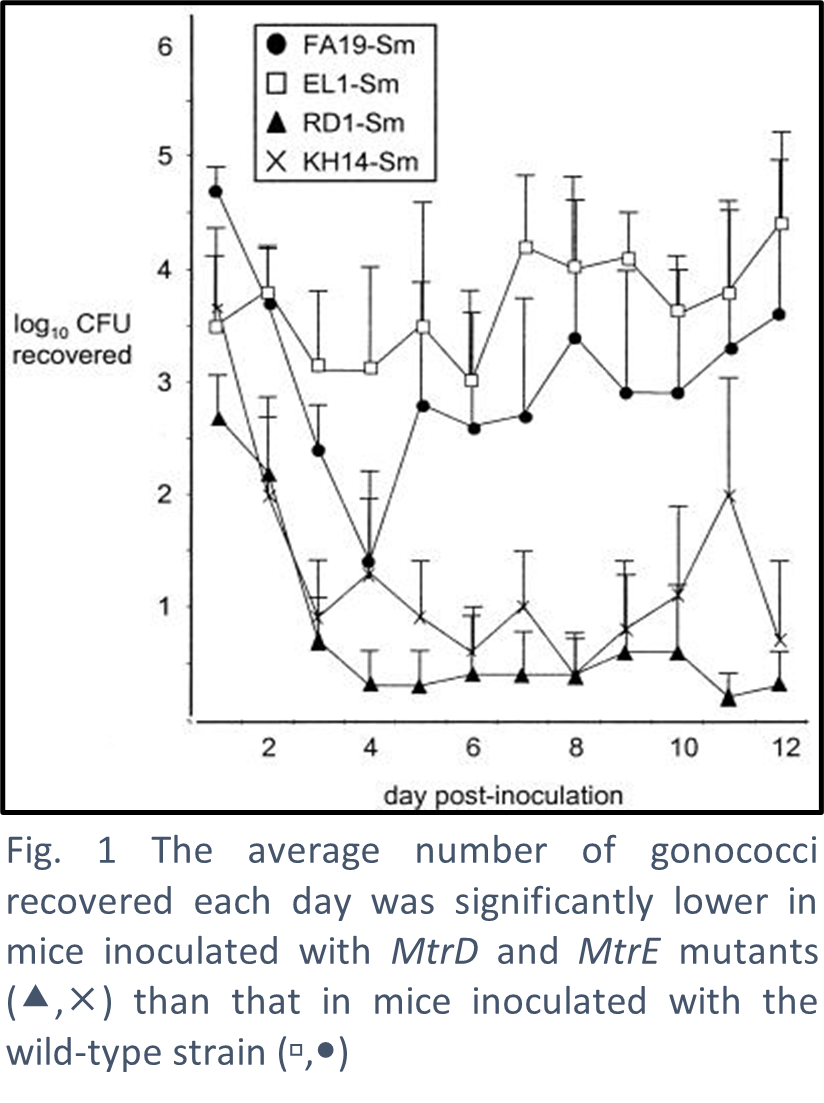 Two such efflux systems, namely, the Mtr encoded by C, D, E genes and far encoded by A,B genes (MtrCDE and farAB), have been well characterized in Neisseria. Since no vaccine currently exists for N. gonorrhoeae, antibiotic therapy is a primary measure of infection control. The emergence of antibiotic-resistant strains, however, continually challenges the effectiveness of antibiotics as a control strategy.
Researchers at USU and HJF have isolated the MtrE protein which naturally occurs in outer membrane of N. gonorhoeae. Studies showed that MtrD-E deficient gonococci were more rapidly cleared from mice that were capable of secreting gonadal hormones when compared to wild strains (Fig.1).
This present invention provides pathway to develop antibodies that specifically bind to the MtrE epitope on N. gonorhoeae. Potential applications include infection diagnosis, immunization to prevent or inhibit infection (vaccine), production of T-cells specific to N. gonorhoeae, and creating vectors for expressing proteins in bacterial hosts.
Inventors
- Ann Jerse, Ph.D., USU
- Amanda DeRocco, Ph.D., HJF
Innovation Status
In vitro inhibition assays were performed. MtrE protein was isolated. Please see Infect Immun. 2003 Oct;71(10):5576-82.
Intellectual Property Status
Issued US patents 9,902,756 and 10,414,805
